
Introduction
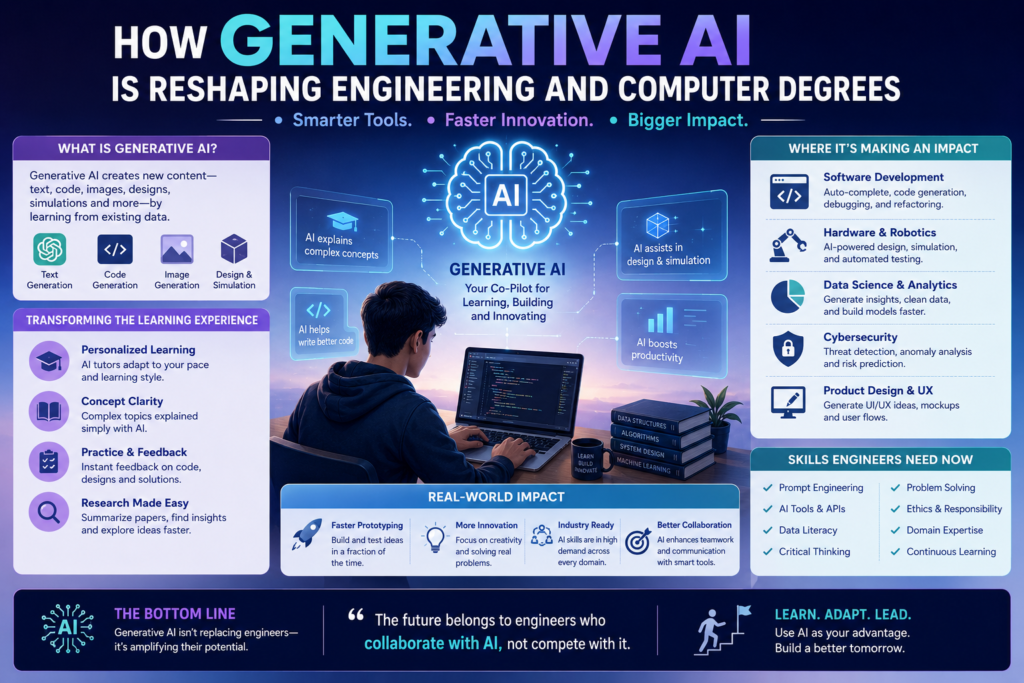
Generative AI is not just a new technology trend—it is fundamentally transforming how engineering and computer science degrees are taught, learned, and applied in the real world. From MCA and B.Tech to M.Tech and computer science programs, students are now experiencing a major shift in curriculum, learning methods, and career expectations.
In 2026, tools like ChatGPT, GitHub Copilot, Gemini, Claude, and AI-powered coding assistants are changing how students write code, complete assignments, build projects, and even prepare for placements.
This transformation raises important questions:
- How is generative AI changing engineering education?
- Will AI replace programming learning in MCA and B.Tech?
- What skills should students learn in the AI era?
- How are universities updating their curriculum in 2026?
- Is generative AI helpful or harmful for students?
This SEO-optimized, AI-friendly, and voice-search-ready guide explains how generative AI is reshaping engineering and computer degrees, along with its impact on learning, careers, skills, and future opportunities.
What Is Generative AI?
Generative AI refers to artificial intelligence systems that can create content such as:
- Text
- Code
- Images
- Videos
- Music
- Software logic
Examples of Generative AI Tools:
- ChatGPT
- GitHub Copilot
- Google Gemini
- Claude AI
- MidJourney
- DALL·E
These tools are now widely used in engineering education and software development.
Why Generative AI Is Transforming Engineering Education
Generative AI is changing education because it can:
- Write code instantly
- Solve complex problems
- Explain technical concepts
- Generate project ideas
- Debug errors automatically
This reduces traditional learning barriers and speeds up skill development.
1. AI Is Changing How Students Learn Programming
Earlier, students spent months learning syntax and debugging errors manually.
Now With Generative AI:
- Code suggestions are instant
- Errors are explained automatically
- Students learn through examples
- Complex logic is simplified
Impact on MCA and CSE Students:
- Faster learning curve
- Better understanding of logic
- Reduced dependency on rote memorization
However, students must still understand core programming concepts to avoid over-dependence.
2. AI Is Redefining Assignments and Homework
Generative AI has completely changed academic assignments.
Before AI:
- Students manually wrote code
- Research took days
- Debugging was time-consuming
After AI:
- AI generates code examples
- Reports are structured automatically
- Students focus on understanding rather than typing
Academic Shift:
Colleges are now focusing on:
- Concept-based evaluation
- Viva and oral exams
- Project-based assessments
3. Curriculum Is Evolving with AI Integration
Engineering and computer science curricula are being updated rapidly.
New Subjects Introduced:
- Artificial Intelligence
- Machine Learning
- Generative AI fundamentals
- Data Science
- Prompt Engineering
- Cloud AI systems
Old Subjects Being Updated:
- Programming courses now include AI tools
- Software engineering includes automation concepts
- Database courses include AI analytics
Universities are shifting from theoretical learning to skill-based education.
4. Rise of AI-Assisted Coding in Software Development
Generative AI is becoming a co-developer.
AI Tools Used in Development:
- GitHub Copilot
- ChatGPT for debugging
- AI code generators
- Automated testing tools
Benefits:
- Faster development speed
- Reduced coding errors
- Improved productivity
- Better code optimization
Impact on Students:
MCA and engineering students must now learn how to:
- Collaborate with AI tools
- Review AI-generated code
- Improve AI suggestions
5. Generative AI Is Changing Final Year Projects
Final year projects are now heavily AI-driven.
Traditional Projects:
- Simple websites
- Basic applications
- Static systems
AI-Based Modern Projects:
- AI chatbots
- Recommendation systems
- Fraud detection models
- Smart healthcare systems
- Automated resume screening tools
New Requirement:
Students must demonstrate real-world AI integration instead of simple applications.
6. Impact on Coding Interviews and Placements
Generative AI is also changing placement preparation.
Traditional Interviews:
- Manual coding tests
- Algorithm questions
- Whiteboard problem solving
AI Era Interviews:
- AI-assisted coding rounds
- System design focus
- Real-world project evaluation
- GitHub portfolio review
New Hiring Trend:
Companies prefer candidates who can:
- Work with AI tools
- Build scalable systems
- Solve practical problems
7. Emergence of Prompt Engineering as a Skill
Prompt engineering is becoming a critical skill in 2026.
What Is Prompt Engineering?
It is the skill of writing effective instructions for AI tools.
Why It Matters:
- Better AI outputs
- Efficient coding assistance
- Faster problem solving
Applications:
- Coding assistance
- Content generation
- Data analysis
- Software automation
MCA students who master prompt engineering gain a strong competitive advantage.
8. AI Is Reducing Traditional Learning Barriers
Generative AI makes learning easier for students.
Benefits:
- Instant explanations
- Step-by-step solutions
- Personalized learning
- 24/7 assistance
Example:
A student struggling with data structures can ask AI for:
- Simplified explanations
- Code examples
- Visual representations
This improves learning efficiency significantly.
9. Shift from Memorization to Skill-Based Learning
AI has reduced the need for memorizing syntax and formulas.
New Learning Focus:
- Problem-solving skills
- Logical thinking
- System design
- AI integration skills
Result:
Students are becoming more practical and industry-ready.
10. AI Is Expanding Career Opportunities
Generative AI has created new job roles.
New Career Roles:
- AI Engineer
- Machine Learning Engineer
- Prompt Engineer
- AI Product Manager
- Automation Engineer
- Data Scientist
Benefits:
- High salary growth
- Global job opportunities
- Remote work flexibility
11. Ethical Challenges of Generative AI in Education
While AI is powerful, it also raises concerns.
Challenges:
- Over-dependence on AI tools
- Reduced critical thinking
- Plagiarism risks
- Skill gap issues
Solution:
Students should use AI as:
- A learning assistant
- Not a replacement for understanding
12. Role of Teachers in the AI Era
Teachers are evolving from lecturers to mentors.
New Roles:
- Guiding AI-based learning
- Designing practical projects
- Evaluating conceptual understanding
- Encouraging innovation
Education is becoming more interactive and skill-focused.
13. How MCA Students Should Adapt to Generative AI
Key Strategies:
1. Learn Core Programming First
Understand fundamentals before using AI tools.
2. Use AI as a Learning Assistant
Ask AI for explanations and debugging help.
3. Build AI-Based Projects
Apply generative AI in real-world applications.
4. Learn Prompt Engineering
Improve interaction with AI tools.
5. Focus on Problem-Solving
Develop logical thinking beyond AI dependency.
14. Future of Engineering Education with AI
The future of engineering education will be:
- AI-driven
- Personalized
- Skill-based
- Project-oriented
Expected Changes:
- AI tutors in classrooms
- Automated evaluation systems
- Virtual labs
- Real-time coding assistants
Voice Search Optimized FAQs
How is generative AI changing engineering education?
Generative AI is changing engineering education by automating coding, improving learning speed, and introducing AI-based tools in curriculum and projects.
Will AI replace programming in MCA and engineering?
No, AI will assist programming but students still need strong coding and problem-solving skills.
What skills should students learn in the AI era?
Students should learn programming, AI tools, prompt engineering, cloud computing, and problem-solving skills.
Is generative AI useful for MCA students?
Yes, it helps in coding, debugging, learning concepts, and building projects faster.
What are the new career opportunities in generative AI?
New careers include AI Engineer, Prompt Engineer, Data Scientist, and Automation Specialist.
Final Thoughts
Generative AI is not replacing engineering and computer science education—it is reshaping it into a more practical, skill-based, and industry-oriented system. MCA and engineering students now have access to powerful tools that accelerate learning, improve coding efficiency, and expand career opportunities.
However, success in the AI era depends on how students use these tools. Those who rely completely on AI without understanding fundamentals will struggle, while those who combine strong basics with AI tools will become highly competitive professionals.
The future of engineering education is collaborative—humans and AI working together. MCA students who adapt early, build real projects, and develop AI-related skills will be well-positioned for high-growth careers in 2026 and beyond.