
Introduction
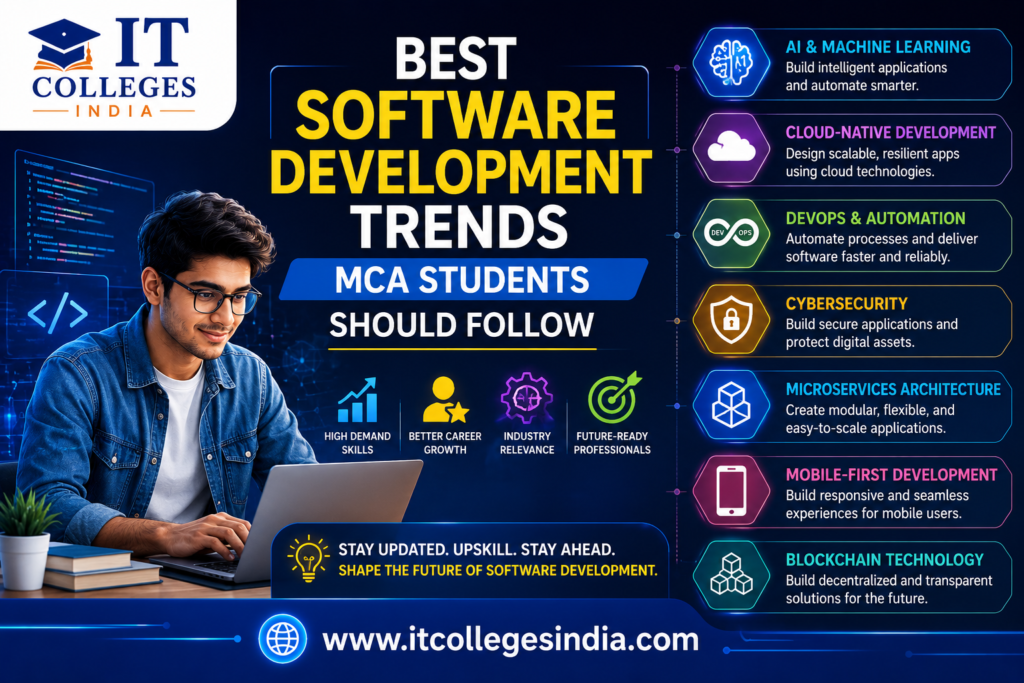
Software development is evolving faster than ever, and MCA students entering the IT industry in 2026 must stay aligned with the latest technologies to remain competitive. Companies are no longer focused only on traditional coding skills; instead, they expect developers to understand AI-powered systems, cloud-native applications, automation, cybersecurity, and modern DevOps practices.
This shift means MCA students must continuously upgrade their skills to match industry expectations.
Many students search for questions like:
- What are the latest software development trends in 2026?
- Which technologies should MCA students learn for placements?
- Is full-stack development still relevant?
- Should MCA students learn AI or cloud computing first?
- What skills are companies expecting from developers today?
This SEO-optimized, AI-friendly, and voice-search-ready guide explains the best software development trends MCA students should follow in 2026, along with skills, tools, career impact, and practical roadmap guidance.
Why MCA Students Must Follow Software Development Trends
The IT industry is driven by rapid innovation. Technologies that were popular five years ago may already be outdated today.
Key Reasons to Stay Updated:
- Companies demand modern tech stacks
- Higher salary opportunities depend on in-demand skills
- Better chances of getting placed in product companies
- Improved project quality and portfolio strength
- Strong global career opportunities
MCA students who stay updated with trends become industry-ready faster than others.
1. Artificial Intelligence (AI) in Software Development
Artificial Intelligence is the most powerful trend shaping software development in 2026.
How AI is Changing Development
- Code generation using AI tools
- Automated testing
- Intelligent debugging
- AI-assisted software design
- Chatbot integration in applications
Tools Used:
- ChatGPT APIs
- GitHub Copilot
- TensorFlow
- PyTorch
Why MCA Students Should Learn AI:
AI skills are no longer optional. Even web developers and app developers are expected to integrate AI features into applications.
2. Full-Stack Development Still Dominates
Full-stack development remains one of the most in-demand skills.
What Full-Stack Developers Do:
They handle:
- Frontend development (UI)
- Backend development (server logic)
- Database management
Popular Tech Stacks:
MERN Stack:
- MongoDB
- Express.js
- React.js
- Node.js
MEAN Stack:
- MongoDB
- Express.js
- Angular
- Node.js
Why It Matters:
Companies prefer developers who can build complete applications independently.
3. Cloud Computing and Cloud-Native Development
Cloud computing is transforming software deployment and scalability.
Major Cloud Platforms:
- AWS
- Microsoft Azure
- Google Cloud Platform
Cloud Trends:
- Serverless architecture
- Containerization
- Microservices
- Cloud-native apps
Important Tools:
- Docker
- Kubernetes
- AWS Lambda
Why MCA Students Should Learn It:
Cloud skills are essential for modern backend and DevOps roles.
4. DevOps and Automation
DevOps is bridging the gap between development and operations.
Key DevOps Practices:
- Continuous Integration (CI)
- Continuous Deployment (CD)
- Automated testing
- Infrastructure as Code
Popular Tools:
- Jenkins
- GitHub Actions
- Docker
- Kubernetes
Benefits:
- Faster software delivery
- Reduced system errors
- Improved collaboration
DevOps engineers are among the highest-paid professionals in IT.
5. Microservices Architecture
Monolithic applications are being replaced by microservices.
What Are Microservices?
Instead of building one large application, developers create small independent services.
Advantages:
- Easy scaling
- Faster updates
- Better system reliability
- Independent deployment
Technologies Used:
- Spring Boot
- Node.js
- Docker
- Kubernetes
6. Cybersecurity-First Development
Security is now part of software design, not an afterthought.
Key Security Trends:
- Secure coding practices
- Zero Trust Architecture
- API security
- Cloud security
Why It Matters:
With increasing cyber threats, companies prioritize secure applications.
Skills Required:
- Ethical hacking basics
- Encryption techniques
- Network security
7. Low-Code and No-Code Development
Low-code platforms are becoming popular for rapid application development.
Platforms:
- Microsoft Power Apps
- OutSystems
- Bubble
- Appgyver
Benefits:
- Faster development
- Reduced coding effort
- Business-friendly tools
Impact on MCA Students:
Even though coding is still important, understanding low-code tools improves productivity.
8. Progressive Web Apps (PWA)
PWAs combine the best features of websites and mobile apps.
Features:
- Offline access
- Fast loading
- Mobile-like experience
- Push notifications
Technologies:
- HTML
- CSS
- JavaScript
- Service Workers
Why PWAs Matter:
They reduce the need for separate Android/iOS development.
9. Mobile-First Development
Mobile usage continues to dominate internet traffic.
Popular Technologies:
- Flutter
- React Native
- Kotlin
- Swift
Trends:
- Cross-platform apps
- Faster UI frameworks
- AI-integrated mobile apps
Why MCA Students Should Learn It:
Mobile apps are essential for startups and enterprises.
10. API-First Development
Modern applications are built using APIs.
What Is API-First Approach?
Applications are designed around APIs before frontend or backend development.
Benefits:
- Better scalability
- Easier integration
- Faster development
Common API Types:
- REST APIs
- GraphQL APIs
11. Blockchain-Based Applications
Blockchain is expanding beyond cryptocurrency.
Applications:
- Smart contracts
- Supply chain tracking
- Digital identity systems
- Secure transactions
Skills Required:
- Solidity
- Ethereum development
- Smart contract programming
12. Edge Computing
Edge computing processes data closer to the user instead of centralized servers.
Benefits:
- Low latency
- Faster processing
- Better real-time performance
Applications:
- IoT devices
- Smart cities
- Autonomous vehicles
13. AI-Powered Development Tools
AI is now directly assisting developers.
Examples:
- Code generation tools
- Automated debugging tools
- AI-based testing frameworks
Impact:
- Faster coding
- Reduced errors
- Improved productivity
MCA students must learn how to use AI tools effectively.
14. Data-Driven Development
Applications are now built around data insights.
Key Areas:
- Data analytics
- Real-time dashboards
- Predictive modeling
Tools:
- Python
- Power BI
- Tableau
15. Git and Open Source Development
Version control is essential for all developers.
Git Skills:
- Branching
- Merging
- Pull requests
- Collaboration
Open Source Benefits:
- Industry exposure
- Real-world projects
- Portfolio building
Skills MCA Students Must Develop Along With Trends
Technical Skills:
- Python
- JavaScript
- Java
- SQL
- Cloud platforms
- AI/ML basics
Soft Skills:
- Communication
- Problem-solving
- Teamwork
- Time management
Career Impact of Following These Trends
MCA students who adopt modern technologies can enter roles like:
- Software Developer
- Full-Stack Engineer
- AI Engineer
- DevOps Engineer
- Cloud Architect
- Cybersecurity Analyst
- Mobile App Developer
These roles offer strong salary growth and global opportunities.
Common Mistakes MCA Students Should Avoid
1. Learning outdated technologies
Old frameworks reduce job opportunities.
2. Ignoring practical projects
Projects are more important than theory.
3. Not using GitHub
Without GitHub, portfolio is incomplete.
4. Avoiding AI tools
AI tools are now part of development workflow.
5. Not following industry trends
Technology changes quickly; outdated skills reduce employability.
Voice Search Optimized FAQs
What are the top software development trends in 2026?
Top trends include Artificial Intelligence, cloud computing, DevOps, microservices, full-stack development, cybersecurity, and AI-powered development tools.
Which skills should MCA students learn for software development?
MCA students should learn programming, AI, cloud computing, DevOps, APIs, mobile development, and cybersecurity skills.
Is full-stack development still in demand?
Yes, full-stack development is still one of the most in-demand skills for software engineers.
Should MCA students learn AI or cloud computing first?
Students should start with programming basics, then learn AI or cloud computing based on career interest.
What is the future of software development?
The future is driven by AI automation, cloud-native systems, microservices, and intelligent applications.
Final Thoughts
Software development in 2026 is driven by innovation, automation, and intelligence. MCA students must go beyond traditional coding and embrace modern technologies like AI, cloud computing, DevOps, and microservices.
Success in the IT industry depends not only on academic knowledge but also on practical skills, real-world projects, and continuous learning.
Students who adapt to these trends early will have a significant advantage in placements, career growth, and global opportunities.
The future belongs to developers who can combine creativity, technical expertise, and modern tools to build scalable, intelligent, and efficient software systems.