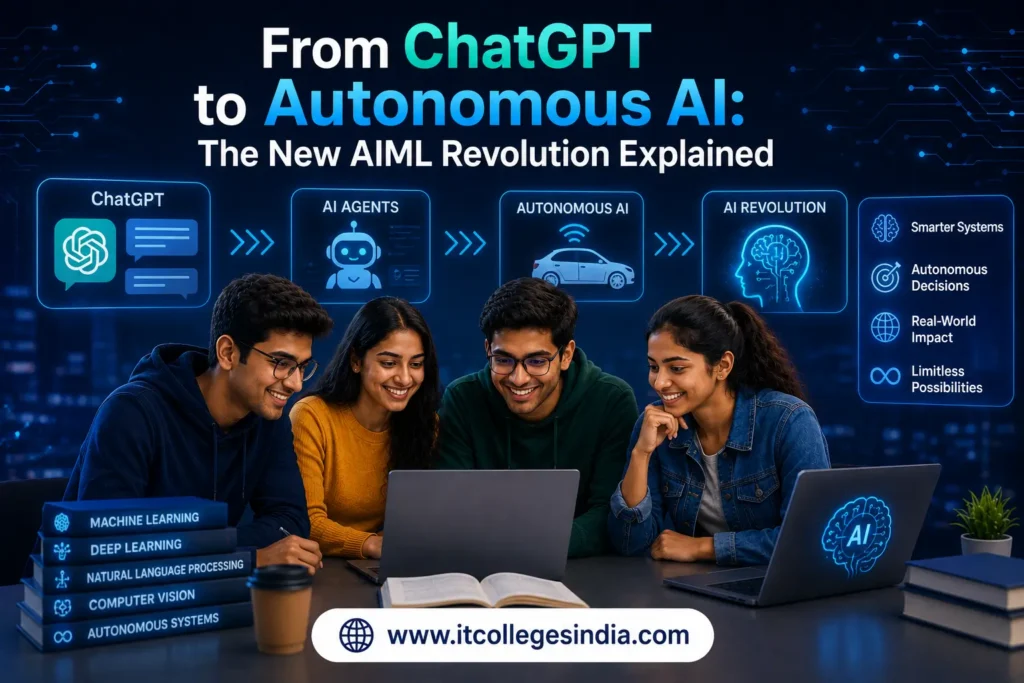

Artificial Intelligence and Machine Learning (AIML) are entering a completely new era in 2026. What started with AI chatbots and virtual assistants has now evolved into autonomous AI systems capable of reasoning, planning, learning, and performing complex tasks with minimal human involvement.
The rise of tools like ChatGPT introduced the world to Generative AI, but the technology landscape is moving even further toward autonomous AI agents that can independently solve problems, automate workflows, and collaborate with humans in real time.
This transformation is creating a massive revolution across industries such as healthcare, education, finance, cybersecurity, software engineering, robotics, and e-commerce.
For students pursuing AIML, B.Tech, CSE, BCA, MCA, Data Science, IoT, and related technology courses, understanding this AI revolution is essential for future career growth.
This article explains the journey from ChatGPT to autonomous AI, how modern AI systems work, industries being transformed, future career opportunities, and what AIML students need to learn in 2026 and beyond.
What Is Generative AI?
Generative AI refers to artificial intelligence systems capable of creating original content such as:
- Text
- Images
- Videos
- Music
- Code
- Audio
- Designs
Unlike traditional AI systems that only analyze data, Generative AI creates new outputs based on learned patterns.
Popular examples include:
- AI chatbots
- AI image generators
- AI coding assistants
- AI content creation tools
- AI voice systems
Generative AI became mainstream after the success of advanced conversational AI platforms like ChatGPT.
How ChatGPT Changed the AI Industry
The launch of conversational AI tools dramatically accelerated AI adoption worldwide.
ChatGPT demonstrated that AI could:
- Understand natural language
- Answer complex questions
- Generate human-like content
- Write code
- Summarize information
- Assist with productivity tasks
This changed public perception of artificial intelligence from a futuristic technology into an everyday productivity tool.
Businesses quickly realized the commercial value of AI-powered automation.
The Evolution Beyond Chatbots
While AI chatbots were revolutionary, they still required constant human prompts and supervision.
The next stage of AI development focuses on autonomous AI systems capable of:
- Making decisions
- Planning actions
- Executing tasks
- Learning continuously
- Collaborating with other AI systems
This shift represents the beginning of the autonomous AI revolution.
What Is Autonomous AI?
Autonomous AI refers to intelligent systems that can operate independently with limited human input.
These AI systems can:
- Analyze goals
- Break tasks into steps
- Access tools and APIs
- Make decisions
- Adapt to changing environments
- Complete workflows automatically
Instead of simply responding to prompts, autonomous AI can perform complete processes independently.
Difference Between ChatGPT and Autonomous AI
| Feature | ChatGPT-Style AI | Autonomous AI |
|---|---|---|
| Responds to prompts | Yes | Yes |
| Executes tasks independently | Limited | Advanced |
| Multi-step reasoning | Basic | Strong |
| Workflow automation | Partial | Full |
| Tool integration | Limited | Extensive |
| Long-term planning | Weak | Advanced |
| Autonomous decision-making | Minimal | High |
Autonomous AI systems represent the next major evolution in AIML technology.
How Autonomous AI Works
Modern autonomous AI systems combine multiple technologies together.
1. Large Language Models (LLMs)
LLMs help AI understand and generate human language.
2. Machine Learning
Machine learning enables systems to improve based on data and experiences.
3. AI Agents
AI agents perform specific tasks such as searching, coding, scheduling, or analyzing information.
4. Memory Systems
Autonomous AI systems store information and remember previous interactions.
5. Tool Integration
AI systems connect with external software, APIs, databases, and applications.
6. Reasoning Engines
Reasoning systems help AI analyze situations and make logical decisions.
Together, these technologies create highly capable intelligent systems.
Why Autonomous AI Is the Biggest AIML Trend in 2026
The rapid growth of autonomous AI is being driven by several major factors.
1. Business Automation Demand
Companies want systems that reduce manual work and improve efficiency.
Autonomous AI can automate:
- Customer support
- Email management
- Data analysis
- Content creation
- Software testing
- Inventory management
Businesses save time and operational costs using AI automation.
2. Rise of AI Agents
AI agents are becoming the foundation of autonomous AI systems.
These agents can:
- Research information
- Analyze documents
- Write reports
- Generate code
- Manage workflows
Multi-agent systems can even collaborate to solve complex tasks.
3. Advances in Generative AI
Modern AI models are becoming more powerful and capable of handling complex instructions.
AI can now:
- Understand context better
- Perform reasoning tasks
- Generate advanced outputs
- Handle multimodal data
This accelerates autonomous AI development.
4. Growth of Cloud Computing
Cloud infrastructure provides scalable computing power for AI systems.
This allows businesses and developers to deploy advanced autonomous AI applications globally.
Industries Being Transformed by Autonomous AI
Autonomous AI is reshaping nearly every major industry.
Healthcare
AI systems are helping doctors with:
- Disease diagnosis
- Medical imaging
- Patient monitoring
- Drug research
- Virtual healthcare assistants
Autonomous healthcare AI improves speed and efficiency in medical systems.
Software Engineering
AI coding assistants are automating:
- Code generation
- Bug fixing
- Documentation
- Testing
- Deployment workflows
Software engineers increasingly work alongside AI systems.
Finance
Banks use autonomous AI for:
- Fraud detection
- Algorithmic trading
- Financial forecasting
- Customer service
- Risk analysis
AI improves speed and decision-making accuracy.
Education
AI-powered learning systems personalize education through:
- AI tutoring
- Adaptive learning
- Automated grading
- Personalized study recommendations
Education technology is rapidly adopting AI automation.
E-Commerce
Online businesses use AI for:
- Product recommendations
- Inventory management
- AI shopping assistants
- Customer support
- Marketing automation
Autonomous AI improves customer experiences and sales efficiency.
Cybersecurity
AI systems help identify:
- Security threats
- Malware attacks
- Network vulnerabilities
- Suspicious activities
AI-powered cybersecurity is becoming essential in modern businesses.
Autonomous AI and the Future of Jobs
One of the biggest concerns surrounding AI is job replacement.
While AI will automate some repetitive tasks, it is also creating new career opportunities.
Jobs Most Likely to Change
AI may automate repetitive roles involving:
- Data entry
- Basic customer support
- Simple coding tasks
- Repetitive reporting
- Manual analysis
However, many jobs will evolve rather than disappear completely.
New Careers Created by Autonomous AI
The AI revolution is creating entirely new job categories.
Popular AI Careers in 2026
| Career Role | Industry Demand |
|---|---|
| AI Engineer | Very High |
| Prompt Engineer | High |
| AI Agent Developer | Very High |
| Machine Learning Engineer | High |
| AI Automation Specialist | Very High |
| AI Research Scientist | Growing |
| AI Product Manager | High |
| Ethical AI Consultant | Emerging |
| Robotics AI Developer | Growing |
Students with AI skills will have strong career opportunities.
What AIML Students Should Learn in 2026
Students must adapt to the changing AI landscape.
1. Learn Python Programming
Python remains the most important language for AI and machine learning.
2. Understand Generative AI
Students should learn:
- Large Language Models
- Prompt engineering
- AI APIs
- AI automation frameworks
3. Learn AI Agent Development
AI agents are becoming one of the most valuable technologies in the industry.
Students should explore:
- LangChain
- AI workflows
- Multi-agent systems
- Automation pipelines
4. Build Real-World Projects
Projects help students gain practical experience.
Useful project ideas include:
- AI chatbots
- AI resume builders
- Autonomous research assistants
- AI coding assistants
- AI recommendation systems
5. Learn Cloud Computing
Cloud skills are essential for deploying AI applications.
Important platforms include:
- AWS
- Azure
- Google Cloud
6. Develop Problem-Solving Skills
Human creativity and strategic thinking remain essential in the AI era.
Students should improve:
- Critical thinking
- Communication
- Team collaboration
- Innovation
Challenges of Autonomous AI
Although autonomous AI offers huge opportunities, there are also major challenges.
Ethical Concerns
AI systems raise concerns about:
- Bias
- Privacy
- Data security
- Transparency
- Responsible AI usage
AI Hallucinations
AI systems sometimes generate inaccurate or misleading outputs.
Human oversight remains important.
Job Disruption
Some traditional roles may decline as automation increases.
Workers must continuously adapt and learn new skills.
High Infrastructure Costs
Advanced AI systems require powerful computing resources and cloud infrastructure.
Future of Autonomous AI Beyond 2026
The future of autonomous AI is expected to expand rapidly.
Upcoming trends include:
- AI-powered robotics
- Smart cities
- Autonomous business systems
- AI personal assistants
- AI-driven scientific research
- Human-AI collaboration platforms
Experts predict that autonomous AI will become deeply integrated into everyday life over the next decade.
Will Autonomous AI Replace Humans Completely?
The answer is no.
AI systems are powerful tools, but humans remain essential for:
- Creativity
- Emotional intelligence
- Leadership
- Ethics
- Innovation
- Strategic thinking
The future is likely to involve collaboration between humans and AI systems rather than full replacement.
Voice Search Optimized FAQs
What is autonomous AI?
Autonomous AI refers to intelligent systems that can perform tasks, make decisions, and automate workflows with minimal human supervision.
How is autonomous AI different from ChatGPT?
ChatGPT mainly responds to prompts, while autonomous AI systems can independently plan, execute, and manage tasks.
Is autonomous AI the future of AIML?
Yes, autonomous AI is becoming one of the biggest trends in Artificial Intelligence and Machine Learning in 2026.
Which skills are important for autonomous AI careers?
Python, machine learning, cloud computing, AI automation, prompt engineering, and AI agent development are highly important skills.
Will autonomous AI replace software engineers?
AI may automate repetitive coding tasks, but human engineers are still needed for creativity, architecture, security, and strategic problem-solving.
Which industries use autonomous AI?
Healthcare, finance, education, cybersecurity, software development, e-commerce, and robotics industries are rapidly adopting autonomous AI.
Conclusion
The journey from ChatGPT to autonomous AI represents one of the biggest technological revolutions in modern history. AI systems are evolving from simple conversational tools into intelligent autonomous agents capable of performing complex tasks independently.
This transformation is changing industries, creating new careers, and redefining the future of technology. For AIML, B.Tech, CSE, BCA, MCA, Data Science, and IoT students, understanding autonomous AI is essential for future success.
Students who learn AI development, machine learning, cloud computing, automation, and AI agent technologies will have significant career advantages in the coming years.
The future of AI is no longer limited to chatbots. Autonomous AI systems are shaping a new generation of intelligent technology, and the AIML revolution is only beginning.
Also Read: How MCA Graduates Can Enter AI and Data Science Careers (2026 Guide)